I was driving along today and saw a particularly striking example of Gymnosporangium juniperi-virginianae (cedar-apple rust) in action! I saw at least three trees in the area with this amazing bright orange fungus, but one of them was completely covered! Here are a few photos that I took:
A side view of one of the fungal fruiting bodies progressing through the stages of maturity.
A particularly juicy fruiting body as seen from below.
A small portion of the tree covered in the fungus.
[Photos by Brendan Hodkinson.]
Sunday, April 25, 2010
Wednesday, April 21, 2010
Lichen Photomorphs in Costa Rica
- Brendan
[Travel and research expenses for the field component of this trip were covered by a handful of small grants: Christiane and Christopher Tyson OTS Research Fellowship, Lewis and Clark Fund for Exploration and Field Research Grant, Sally Hughes-Schrader Travel Grant, & Explorers Club Diversa Award.]
Sunday, April 11, 2010
Lichens in the Community
Haven't you always wanted to go to a festival and find an exhibit all about lichens?! This weekend I was lucky enough to have an opportunity to participate in the 10th Annual WOODSmont Children's Festival sponsored by Duke University's Wilderness Outdoor Opportunities for Durham Students ('WOODS'). I set up a table with a full exhibit including 'touch and feel' lichens, a microscope (so that children could see the lichens up close), a collage of amazing photos of lichens from around the world (thanks to Robert Lücking for compiling these), and 'pet lichens' for children to take home. Here is a photo of the exhibit itself:
This picture shows an action shot of some local children becoming aware of the lichens in their neighborhood:
It was a great day, and I look forward to more opportunities for this type of outreach!
-Brendan
[Many thanks to the National Science Foundation for funding my research and associated outreach through a recent Doctoral Dissertation Improvement Grant: DEB-1011504.]
This picture shows an action shot of some local children becoming aware of the lichens in their neighborhood:
It was a great day, and I look forward to more opportunities for this type of outreach!
-Brendan
[Many thanks to the National Science Foundation for funding my research and associated outreach through a recent Doctoral Dissertation Improvement Grant: DEB-1011504.]
Tuesday, April 6, 2010
Submitting to GenBank
Anyone who does much in the way of DNA sequencing/analysis eventually has to deal with depositing sequences in GenBank. For a sequence or two, it is relatively simple to use the online 'BankIt' submission system. However, for larger batches it becomes necessary to take advantage of the batch functions available with the 'Sequin' program. To get to the point of being able to submit large batches each containing multiple 'features', there is quite a steep learning curve (especially if you are trying to teach yourself). Unfortunately, the web-pages on the NCBI website do not seem quite sufficient to make submission a simple process. While submitting sequences for a number of recent papers (e.g., Hodkinson & Lutzoni 2009, Hodkinson & Lendemer 2010, Lendemer & Hodkinson 2009, 2010), I wrote myself a tutorial on how to submit RNA-encoding sequences (rRNA, introns, transcribed spacers, etc.) to GenBank. Most of this will apply to all sequence types, but getting the information for protein-coding sequences correct might still be an issue requiring some extra assistance. In the 16-step outline below, the most difficult and problematic aspect (i.e., annotating multiple sequence features) is emphasized and greater detail is given in this area.
GenBank Submission Using SEQUIN:
1) Make a FASTA+GAP file with bracketed modifiers for all basic info that varies between sequences (e.g., organism, isolate, specimen-voucher, etc.; for basic formatting see http://www.ncbi.nlm.nih.gov/ Sequin/QuickGuide/sequin.htm# AlignmentFormats; for appropriate modifiers see http://www.ncbi.nlm.nih.gov/ Sequin/QuickGuide/sequin.htm# DefinitionLine).
2) Run SEQUIN and type in the authorship, contact, and citation information that applies to all sequences.
3) Import file into SEQUIN as a 'Phylogenetic Study' set in 'FASTA+GAP' format.
4) Click 'Edit' 'Alignment Assistant...'.
5) Click 'Features' 'Apply To Alignment >' 'RNA'.
6) For the feature that you wish to annotate, be sure to check the box saying if the 5' or 3' end is partial, if either one is.
7) Type in the alignment coordinates of the particular feature that you are annotating.
8) In the 'RNA Type' box, pick the type of feature (e.g., 'misc_RNA' for ITS1 and ITS2, or 'rRNA' for 18S, 5.8S, or 28S).
9) In the field next to 'RNA Name', put in the specific type of RNA (18S ribosomal RNA, internal transcribed spacer 1, etc.).
10) Click 'Accept.'
11) Repeat steps 5-10 for each section of RNA in the sequence set.
12) In the 'Alignment Assistant' window, go to the 'File' menu and click 'Close'.
13) To check/edit your work: next to 'Target Sequence' choose 'ALL SEQUENCES' and next to 'Format' choose 'Graphic' (double-click on any particular feature annotation to see details and/or make changes; if a particular annotation is entirely erronious, highlight the annotation and go to 'Edit' then 'Clear').
14) Click 'Done' on the main viewing window.
15) When it asks 'Are you ready to save the record?' click 'Yes'.
16) Save the file to the hard drive and email it to 'gb-sub@ncbi.nlm.nih.gov'.
I have been told that this protocol is helpful in getting Sequin to 'work'. I hope that posting it here will help even more people!
- Brendan
[If you found this post to be a useful guide, and employed the information found here as part of the GenBank submission process, please cite this work as follows:
Hodkinson, B. P. 2010. Submitting to GenBank. Squamules Unlimited, Durham, NC. http://squamules.blogspot.com/2010/04/submitting-to-genbank.html
Many thanks!]
Works Cited:
Hodkinson, B. P., and F. Lutzoni. 2009. A microbiotic survey of lichen-associated bacteria reveals a new lineage from the Rhizobiales. Symbiosis 49: 163-180.
Download publication (PDF file)
Download alignment (NEXUS file)
Hodkinson, B. P., and J. C. Lendemer. In press. Molecular analyses reveal semi-cryptic species in Xanthoparmelia tasmanica. Bibliotheca Lichenologica.
Download draft (PDF file)
Download alignment (NEXUS file)
Lendemer, J. C., and B. P. Hodkinson. 2009. The Wisdom of Fools: new molecular and morphological insights into the North American apodetiate species of Cladonia. Opuscula Philolichenum 7: 79-100.
Download publication (PDF file)
Download alignment (NEXUS file)
Lendemer, J. C., and B. P. Hodkinson. 2010. A new perspective on Punctelia subrudecta in North America: previously-rejected morphological characters corroborate molecular phylogenetic evidence and provide insight into an old problem. The Lichenologist 42(4): 405-421.
Download publication (PDF file)
Download alignment (NEXUS file)
GenBank Submission Using SEQUIN:
1) Make a FASTA+GAP file with bracketed modifiers for all basic info that varies between sequences (e.g., organism, isolate, specimen-voucher, etc.; for basic formatting see http://www.ncbi.nlm.nih.gov/
2) Run SEQUIN and type in the authorship, contact, and citation information that applies to all sequences.
3) Import file into SEQUIN as a 'Phylogenetic Study' set in 'FASTA+GAP' format.
4) Click 'Edit' 'Alignment Assistant...'.
5) Click 'Features' 'Apply To Alignment >' 'RNA'.
6) For the feature that you wish to annotate, be sure to check the box saying if the 5' or 3' end is partial, if either one is.
7) Type in the alignment coordinates of the particular feature that you are annotating.
8) In the 'RNA Type' box, pick the type of feature (e.g., 'misc_RNA' for ITS1 and ITS2, or 'rRNA' for 18S, 5.8S, or 28S).
9) In the field next to 'RNA Name', put in the specific type of RNA (18S ribosomal RNA, internal transcribed spacer 1, etc.).
10) Click 'Accept.'
11) Repeat steps 5-10 for each section of RNA in the sequence set.
12) In the 'Alignment Assistant' window, go to the 'File' menu and click 'Close'.
13) To check/edit your work: next to 'Target Sequence' choose 'ALL SEQUENCES' and next to 'Format' choose 'Graphic' (double-click on any particular feature annotation to see details and/or make changes; if a particular annotation is entirely erronious, highlight the annotation and go to 'Edit' then 'Clear').
14) Click 'Done' on the main viewing window.
15) When it asks 'Are you ready to save the record?' click 'Yes'.
16) Save the file to the hard drive and email it to 'gb-sub@ncbi.nlm.nih.gov'.
I have been told that this protocol is helpful in getting Sequin to 'work'. I hope that posting it here will help even more people!
- Brendan
[If you found this post to be a useful guide, and employed the information found here as part of the GenBank submission process, please cite this work as follows:
Hodkinson, B. P. 2010. Submitting to GenBank. Squamules Unlimited, Durham, NC. http://squamules.blogspot.com/2010/04/submitting-to-genbank.html
Many thanks!]
Works Cited:
Hodkinson, B. P., and F. Lutzoni. 2009. A microbiotic survey of lichen-associated bacteria reveals a new lineage from the Rhizobiales. Symbiosis 49: 163-180.
Download publication (PDF file)
Download alignment (NEXUS file)
Hodkinson, B. P., and J. C. Lendemer. In press. Molecular analyses reveal semi-cryptic species in Xanthoparmelia tasmanica. Bibliotheca Lichenologica.
Download draft (PDF file)
Download alignment (NEXUS file)
Lendemer, J. C., and B. P. Hodkinson. 2009. The Wisdom of Fools: new molecular and morphological insights into the North American apodetiate species of Cladonia. Opuscula Philolichenum 7: 79-100.
Download publication (PDF file)
Download alignment (NEXUS file)
Lendemer, J. C., and B. P. Hodkinson. 2010. A new perspective on Punctelia subrudecta in North America: previously-rejected morphological characters corroborate molecular phylogenetic evidence and provide insight into an old problem. The Lichenologist 42(4): 405-421.
Download publication (PDF file)
Download alignment (NEXUS file)
Tuesday, March 30, 2010
Eagle Summit, Alaska
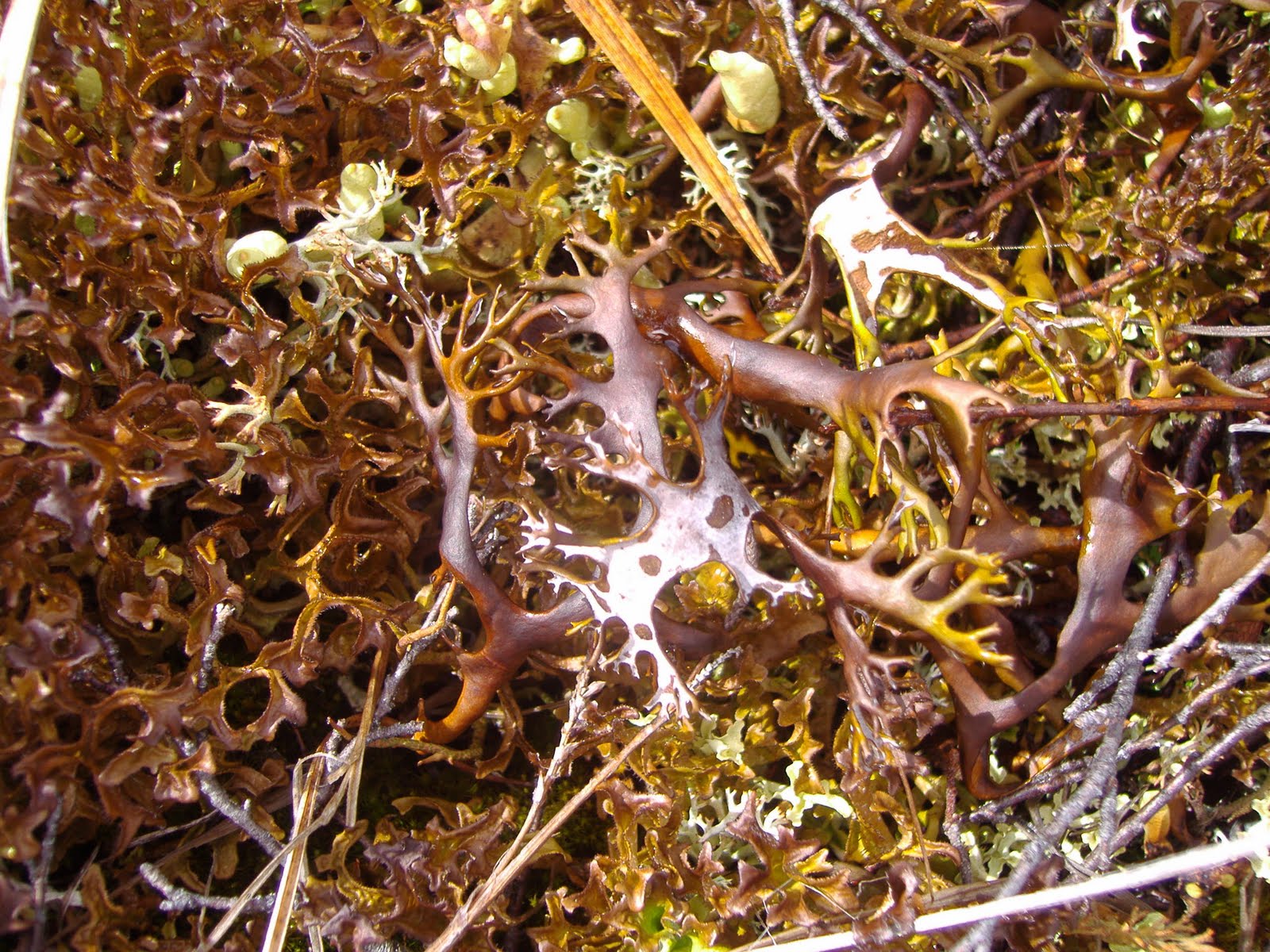
The summer before last I traveled to Alaska in search of lichens. It was an amazing trip! There were lichens aplenty (in terms of biomass); however, there was noticeably less diversity than one might find in temperate regions or, of course, tropical regions. This did not diminish my excitement when I saw the lichens of the tundra piled high on top of one another all along the ground. Here are just a few photos of the amazing lichens of Eagle Summit, near Fairbanks, Alaska:
Masonhalea richardsonii
Solorina crocea

Ophioparma ventosa
Dactylina arctica

Alectoria ochroleuca
Flavocetraria cucullata

Thamnolia vermicularis

Cladonia pleurota

Sphaerophorus globosus
Stay tuned for more photos from some of the other sites that I visited in Alaska!
-Brendan
[Funding for this excursion was provided by NSF Award DEB-0640956.]
Masonhalea richardsonii
Solorina crocea
Ophioparma ventosa
Dactylina arctica
Alectoria ochroleuca
Flavocetraria cucullata
Thamnolia vermicularis
Cladonia pleurota
Sphaerophorus globosus
Stay tuned for more photos from some of the other sites that I visited in Alaska!
-Brendan
[Funding for this excursion was provided by NSF Award DEB-0640956.]
Saturday, March 6, 2010
Cladonia stipitata Lendemer & Hodkinson, a new species (with squamules!)
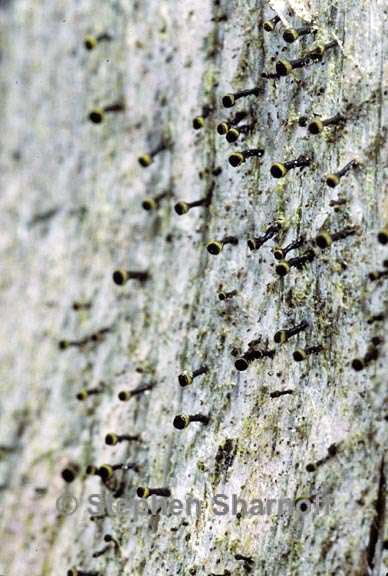
I recently worked with James Lendemer of the New York Botanical Garden on a paper that sorts out the taxonomy of the Cladonia lichens in eastern North America that carry out a full sexual life cycle without ever producing podetia (Lendemer & Hodkinson 2009). Since podetial morphology is typically the most informative character (or set of characters) used for identifying Cladonia specimens, this group has previously been either neglected or treated in a very incomplete manner. We used a combination of molecular and morphological analyses to better define the morphological/ecological/biogeographical boundaries of several named species, and were able to describe an entirely new species that is well-supported by morphology, ecology, chemistry, and gene sequence data. The new species is known as Cladonia stipitata Lendemer & Hodkinson. It has an interesting morphology that includes a narrow, blackened stipe upon which the squamules sit. The underside of some extremely well-developed specimens on barren rock can have a substantial mass of these distinct thin black stipes, something quite unique in the genus Cladonia.
Plate 5 (Lendemer & Hodkinson 2009). Cladonia stipitata. Figure 1, thallus (Harris 30810, scale = 5 mm). Figure 2, detail of the primary squamules (Harris 38010, scale = 1mm). Figure 3, typical habitat (Jackson Co., North Carolina, USA, photo by E.A. Tripp). Figure 4, detail of apothecium (Lendemer 7615, scale = 2 mm).
In the paper, we also provide a key to the typically sterile Cladonia lichens in eastern North America (which includes many species that have their reproductive structures on podetia, but only rarely reproduce sexually and are therefore without podietia in most collections) and briefly discuss some of the potential forces at work in the evolution of fungal introns. The title of the work is "The Wisdom of Fools: new molecular and morphological insights into the North American apodetiate species of Cladonia", and it is derived from a quote by Dr. Richard C. Harris ("Dick", from the New York Botanical Garden) stating that "the common wisdom [is] that only fools collect sterile Cladonia" (Harris 1992; note: species that complete the sexual lifecycle without producing podetia are typically grouped in with the 'sterile' species due to their odd mode of reproduction). Feel free to read our paper here, or check it out in volume 7 of Opuscula Philolichenum (Festschrift für Richard C. Harris).
-Brendan Hodkinson, Duke University
Works Cited:
Harris, R. C. 1992. Cladonia petrophila, a new species from eastern North America. Brittonia 44(3): 326-330.
Lendemer, J. C., and B. P. Hodkinson. 2009. The Wisdom of Fools: new molecular and morphological insights into the North American apodetiate species of Cladonia. Opuscula Philolichenum 7: 79-100.
Download publication (PDF file)
Plate 5 (Lendemer & Hodkinson 2009). Cladonia stipitata. Figure 1, thallus (Harris 30810, scale = 5 mm). Figure 2, detail of the primary squamules (Harris 38010, scale = 1mm). Figure 3, typical habitat (Jackson Co., North Carolina, USA, photo by E.A. Tripp). Figure 4, detail of apothecium (Lendemer 7615, scale = 2 mm).
In the paper, we also provide a key to the typically sterile Cladonia lichens in eastern North America (which includes many species that have their reproductive structures on podetia, but only rarely reproduce sexually and are therefore without podietia in most collections) and briefly discuss some of the potential forces at work in the evolution of fungal introns. The title of the work is "The Wisdom of Fools: new molecular and morphological insights into the North American apodetiate species of Cladonia", and it is derived from a quote by Dr. Richard C. Harris ("Dick", from the New York Botanical Garden) stating that "the common wisdom [is] that only fools collect sterile Cladonia" (Harris 1992; note: species that complete the sexual lifecycle without producing podetia are typically grouped in with the 'sterile' species due to their odd mode of reproduction). Feel free to read our paper here, or check it out in volume 7 of Opuscula Philolichenum (Festschrift für Richard C. Harris).
-Brendan Hodkinson, Duke University
Works Cited:
Harris, R. C. 1992. Cladonia petrophila, a new species from eastern North America. Brittonia 44(3): 326-330.
Lendemer, J. C., and B. P. Hodkinson. 2009. The Wisdom of Fools: new molecular and morphological insights into the North American apodetiate species of Cladonia. Opuscula Philolichenum 7: 79-100.
Download publication (PDF file)
Tuesday, February 16, 2010
What is a species?
Those who belong to the official lichen listserve, 'LICHENS-L', may remember a few months ago when someone threw out the fact that some biologists have adopted the notion that "There is nothing unique or special about the 'species' as a taxonomic rank". This idea is not in any way unique to lichenology, but within that forum I gave the following response:
"
There is no question that genetic recombination creates forces that maintain uniformity and keep members of 'species' morphologically and molecularly similar to one another; this is not the case for higher taxonomic ranks, where similarity within a group can generally be attributed only to common ancestry or ecology. When these forces break down permanently because of some reproductive barrier, we generally call that a 'speciation' event. This is obviously based on a Biological Species Concept (BSC) which says that a 'species' is essentially a group of interbreeding individuals reproductively isolated from other such groups. From my perspective, that is the only 'real,' justifiable species concept. However, other species concepts (e.g., phylogenetic, morphological) are perfectly valid in that they provide excellent insight into what the groups of interbreeding individuals are likely to be (this is usually very hard to demonstrate experimentally, so the BSC is often not practical from a scientific standpoint).
Of course, this leaves out asexual organisms, and those must be pigeon-holed because the species are not 'real' (i.e., they do not represent anything uniquely different from any other taxonomic rank). In these cases, species merely become names for phylogenetic entities possessing shared innovations that have altered the course of their evolutionary history (still valid, but no different from genera, families, etc.).
We must also not forget hybridization, polyploidy, etc., which can throw a wrench into the system. These events can have major effects and cause instant 'speciation' (reproductive isolation) even though they are seemingly quite rare. In some cases you can get new species with multiple progenitor species. We have good examples of this in plants, but I really wouldn't be surprised to find all sorts of crazy things that we just do not know about yet happening in the fungi!
If your perspective is only phylogenetic, then it is true that 'species' often do not show up clearly and distinctly as special units per se. However, if you can analyze a combination of molecular, morphological, ecological, and geographical features of organisms, then you can begin to infer 'biological species' by assuming that there are forces maintaining some degree of uniformity within each unit (but as I implied above, this is not always a sound assumption).
"
There is no doubt that the question of 'what makes a species' is a difficult one (the evidence for this is in the fact there there are so many well-accepted 'species concepts'), but it does not mean that we should throw out our species concepts and simply say that 'species' is just another taxonomic rank like any other. If we do this, we are likely to miss the significance of certain phenomena that take place all around us in the natural world.
-Brendan Hodkinson, Duke University
"
There is no question that genetic recombination creates forces that maintain uniformity and keep members of 'species' morphologically and molecularly similar to one another; this is not the case for higher taxonomic ranks, where similarity within a group can generally be attributed only to common ancestry or ecology. When these forces break down permanently because of some reproductive barrier, we generally call that a 'speciation' event. This is obviously based on a Biological Species Concept (BSC) which says that a 'species' is essentially a group of interbreeding individuals reproductively isolated from other such groups. From my perspective, that is the only 'real,' justifiable species concept. However, other species concepts (e.g., phylogenetic, morphological) are perfectly valid in that they provide excellent insight into what the groups of interbreeding individuals are likely to be (this is usually very hard to demonstrate experimentally, so the BSC is often not practical from a scientific standpoint).
Of course, this leaves out asexual organisms, and those must be pigeon-holed because the species are not 'real' (i.e., they do not represent anything uniquely different from any other taxonomic rank). In these cases, species merely become names for phylogenetic entities possessing shared innovations that have altered the course of their evolutionary history (still valid, but no different from genera, families, etc.).
We must also not forget hybridization, polyploidy, etc., which can throw a wrench into the system. These events can have major effects and cause instant 'speciation' (reproductive isolation) even though they are seemingly quite rare. In some cases you can get new species with multiple progenitor species. We have good examples of this in plants, but I really wouldn't be surprised to find all sorts of crazy things that we just do not know about yet happening in the fungi!
If your perspective is only phylogenetic, then it is true that 'species' often do not show up clearly and distinctly as special units per se. However, if you can analyze a combination of molecular, morphological, ecological, and geographical features of organisms, then you can begin to infer 'biological species' by assuming that there are forces maintaining some degree of uniformity within each unit (but as I implied above, this is not always a sound assumption).
"
There is no doubt that the question of 'what makes a species' is a difficult one (the evidence for this is in the fact there there are so many well-accepted 'species concepts'), but it does not mean that we should throw out our species concepts and simply say that 'species' is just another taxonomic rank like any other. If we do this, we are likely to miss the significance of certain phenomena that take place all around us in the natural world.
-Brendan Hodkinson, Duke University
Tuesday, February 9, 2010
Top Lichens
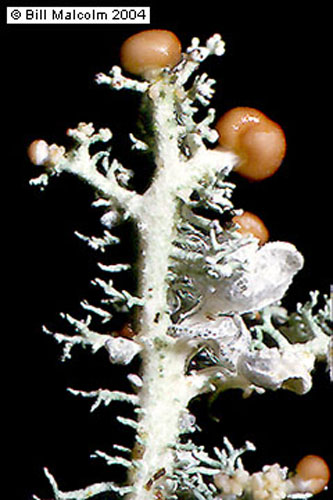
Dr. Robert Lücking (Field Museum, Chicago) recently asked lichenologists to send in a list of their top 5-20 favorite lichen species. Along with Dr. Thorsten Lumbsch (also of the Field Museum) and others, he plans to assemble a list of 100 lichens, and eventually each will be featured on a website with its own page full of photos and information about the species. Feel free to peruse my current top 20 lichens; each name has a link to a photograph of the species.
Arthonia caesia
Brigantiaea leucoxantha
Calicium trabinellum
Chaenotheca furfuracea
Cladonia bellidiflora
Conotrema urceolatum
Dibaeis baeomyces
Glyphis cicatricosa
Gyalideopsis buckii
Herpothallon rubrocinctum
Masonhalea richardsonii
Niebla cephalota
Ochrolechia oregonensis
Pilophorus clavatus
Placopsis lambii
Solorina crocea
Sphaerophorus globosus
Stereocaulon ramulosum
Umbilicaria cylindrica
Usnea longissima
I look forward to seeing how this project evolves! It will be a great way to reach out to those outside of the field of lichenology and demonstrate the beauty and diversity of lichen-forming fungi!
- Brendan
Arthonia caesia
Brigantiaea leucoxantha
Calicium trabinellum
Chaenotheca furfuracea
Cladonia bellidiflora
Conotrema urceolatum
Dibaeis baeomyces
Glyphis cicatricosa
Gyalideopsis buckii
Herpothallon rubrocinctum
Masonhalea richardsonii
Niebla cephalota
Ochrolechia oregonensis
Pilophorus clavatus
Placopsis lambii
Solorina crocea
Sphaerophorus globosus
Stereocaulon ramulosum
Umbilicaria cylindrica
Usnea longissima
I look forward to seeing how this project evolves! It will be a great way to reach out to those outside of the field of lichenology and demonstrate the beauty and diversity of lichen-forming fungi!
- Brendan
Wednesday, February 3, 2010
Tasty Fungi
Over the past few days I've been trying out some new recipes with my wife and we came up with this one that seemed to be worth sharing! It's loosely based on a recipe from a 2003 issue of Vegetarian Times, picked up from a library book sale (though we have so altered it that I'm not sure that it would be clear what it's based on anyway!). The dish is called 'Mushroom Couscous Cakes' and it ended up being much better than either of us expected. My wife made it clear from the start that she was skeptical, since she says that she does not like fungi, but once she tasted it she changed her mind!
This recipe seems to work best in a less formal setting, since the cakes are amazing when they first come off of the skillet, and it may be best for some people to start eating while others are waiting for their cakes to be prepared. I highly recommend porcini mushrooms in the cakes, but the mushroom mix that goes on top could be made with any number of different types of fungi (e.g., chanterelles, morels, creminis/portobellos, etc.... I wonder if it could work with Umbilicaria....); we had shiitakes in our kitchen and they were great!
Mushroom Couscous Cakes
Serves 4
Cakes:
1/4 oz. dried porcini mushrooms
1/2 cup couscous
1/2 onion, chopped
1/2 tsp. salt
1 egg
1 Tbs. all-purpose flour
Extra virgin olive oil, as needed
Mushroom Mixture:
1 Tbs. extra virgin olive oil
1/2 lb. cleaned, dried shiitake mushrooms
Salt and freshly-ground pepper to taste
1/2 onion, finely chopped
1 clove garlic, finely chopped
1/3 cup dry white wine
1 Tbs. butter
1/4 tsp. Cavender's All-Purpose Greek Seasoning (a mix of salt, pepper, corn starch, garlic, MSG, and oregano)
To prepare dried mushrooms:
Put each type of mushroom in its own separate bowl, fill each bowl with warm water, squeeze mushrooms, pour off water, and repeat several times until mushrooms are reconstituted and the water remains somewhat clear when mushrooms are squeezed.
To make batter for cakes:
Chop porcini mushrooms very fine. Place couscous, 1/2 onion, salt, chopped porcini mushrooms, and 1 cup of water in a small saucepan. Bring to a simmer, cover and reduce heat. Cook for 25 minutes or until couscous absorbs all liquid. Transfer to mixing bowl and cool. Stir in egg and flour.
To make mushroom mix:
Heat olive oil in large skillet over medium-high heat. Add mushrooms, season with salt and cook, tossing from time to time, until mushrooms release moisture and begin to brown. Add onions and garlic, cook 1 minute more and add wine. Continue to cook until only a small bit of liquid remains. Stir in butter and seasoning mix. Transfer to bowl/saucepan and keep warm while making cakes.
To make cakes:
Pour 1/8 inch layer of olive oil into a large skillet and heat over medium heat. When oil is hot, drop in 2 tablespoon-sized mounds of couscous batter and flatten slightly (if they are too flat, they might start to come apart, but then you can make 'couscous cracklins' which are probably very good too!). Cook until browned on bottoms, flip and brown top (we almost set off the fire alarm during this step!). Repeat with remaining batter until used up.
To serve:
Toss each cake onto a small plate and top with a couple of tablespoons of the mushroom mixture.
My preferred way to eat them is to toss them onto a few napkins and squeeze the oil out of them before topping them with a handful of mushrooms. This allows you to get the nice fried flavor with a little less fat, but it does somewhat deform the cakes!
I hope some of you reading this get a chance to try it! Please let me know if you do!
- Brendan
This recipe seems to work best in a less formal setting, since the cakes are amazing when they first come off of the skillet, and it may be best for some people to start eating while others are waiting for their cakes to be prepared. I highly recommend porcini mushrooms in the cakes, but the mushroom mix that goes on top could be made with any number of different types of fungi (e.g., chanterelles, morels, creminis/portobellos, etc.... I wonder if it could work with Umbilicaria....); we had shiitakes in our kitchen and they were great!
Mushroom Couscous Cakes
Serves 4
Cakes:
1/4 oz. dried porcini mushrooms
1/2 cup couscous
1/2 onion, chopped
1/2 tsp. salt
1 egg
1 Tbs. all-purpose flour
Extra virgin olive oil, as needed
Mushroom Mixture:
1 Tbs. extra virgin olive oil
1/2 lb. cleaned, dried shiitake mushrooms
Salt and freshly-ground pepper to taste
1/2 onion, finely chopped
1 clove garlic, finely chopped
1/3 cup dry white wine
1 Tbs. butter
1/4 tsp. Cavender's All-Purpose Greek Seasoning (a mix of salt, pepper, corn starch, garlic, MSG, and oregano)
To prepare dried mushrooms:
Put each type of mushroom in its own separate bowl, fill each bowl with warm water, squeeze mushrooms, pour off water, and repeat several times until mushrooms are reconstituted and the water remains somewhat clear when mushrooms are squeezed.
To make batter for cakes:
Chop porcini mushrooms very fine. Place couscous, 1/2 onion, salt, chopped porcini mushrooms, and 1 cup of water in a small saucepan. Bring to a simmer, cover and reduce heat. Cook for 25 minutes or until couscous absorbs all liquid. Transfer to mixing bowl and cool. Stir in egg and flour.
To make mushroom mix:
Heat olive oil in large skillet over medium-high heat. Add mushrooms, season with salt and cook, tossing from time to time, until mushrooms release moisture and begin to brown. Add onions and garlic, cook 1 minute more and add wine. Continue to cook until only a small bit of liquid remains. Stir in butter and seasoning mix. Transfer to bowl/saucepan and keep warm while making cakes.
To make cakes:
Pour 1/8 inch layer of olive oil into a large skillet and heat over medium heat. When oil is hot, drop in 2 tablespoon-sized mounds of couscous batter and flatten slightly (if they are too flat, they might start to come apart, but then you can make 'couscous cracklins' which are probably very good too!). Cook until browned on bottoms, flip and brown top (we almost set off the fire alarm during this step!). Repeat with remaining batter until used up.
To serve:
Toss each cake onto a small plate and top with a couple of tablespoons of the mushroom mixture.
My preferred way to eat them is to toss them onto a few napkins and squeeze the oil out of them before topping them with a handful of mushrooms. This allows you to get the nice fried flavor with a little less fat, but it does somewhat deform the cakes!
I hope some of you reading this get a chance to try it! Please let me know if you do!
- Brendan
Thursday, January 21, 2010
The Lichen as a Microcosm
In the spirit of the International Year of Biodiversity, I thought it would be appropriate to open a discussion about an unexplored environment in which we are currently finding an amazing number of new lineages of organisms that were not previously known to science. The environment of which I speak is: The Lichen! There is an ever-increasing body of evidence to show that the lichen exists not simply as a dual partnership between a fungus and an alga, but as a microcosm comprised of a diverse assemblage of specific microbial lineages.
Researchers often go to exotic locations and so-called 'extreme' environments to find new organisms, but in order to find a treasure-trove of new organismal lineages, all we really have to do is look more closely at some of the common, ordinary micro-environments such as lichens. Recently, a microbiotic survey of lichens involving molecular cloning has uncovered an entirely new lineage of bacteria from the order Rhizobiales (Hodkinson and Lutzoni 2009) that seems to thrive in association with a diversity of lichens. Additionally, the survey uncovered a great deal more bacterial diversity that has yet to be studied in depth.
Another recent study found an entirely new lineage of Cyanobacteria that seems to be exclusively associated with lichens (Lücking et al. 2009). However, the interesting aspect of this story is that the cyanobacterial lineage is associated with several diverse lineages of lichen-forming fungi that bare no resemblance to one another and share no common ancestry. It seems that the members of this cyanobacterial lineage may have evolved to be 'good symbionts' and have subsequently been adopted by several ecologically similar lineages of lichenized fungi. The authors draw the analogy of crop domestication by humans, with Cyanobacteria as the 'crops' being shared by several specific groups of fungi.
Though lichens are known to have a dominant fungal partner, it has recently been discovered that healthy lichen thalli also host various undescribed lineages of 'endolichenic' fungi (fungi that inhabit seemingly healthy lichens and do not reveal any outward signs of their existence). Phylogenetic analyses of these fungi suggest that lichens may act as cradles of microbial diversification, and that the endolichenic state may facilitate transitions to other lifestyles (e.g., living inside of plants; Arnold et al. 2009).
As mentioned before, 'extreme' environments are often thought to be good places to search for undiscovered diversity. However, the definition of an 'extreme' environment has perhaps been too narrow. In a sense, the lichen thallus can be seen as an extreme micro-environment, since lichen-forming fungi often produce abundant acidic secondary compounds that may serve to eliminate some of the common, or 'weedy', environmental microbes. This would open up the environment of the lichen thallus for other microbial lineages, and potentially lead to the co-evolution of specific microbes alongside with their lichen hosts.
In addition to the microbial diversity found in lichen thalli, lichenologists are still hard at work constantly defining new lichen species (species of lichens are named based on the identity of the major fungal partner). Though some of these species are actually rather conspicuous and distinctive, various issues (lack of adequate collections, confusion based on solely morphological evaluations) have left many species without names. Now, using molecular tools to test hypotheses based on careful morphological/chemical/ecological evaluations, many new species are being discovered and the boundaries of others are being more clearly defined (e.g., Lendemer and Hodkinson 2009, Lendemer and Hodkinson 2010, Hodkinson and Lendemer 2010).
But let us not forget the algae in this whole story! It has been known for quite some time that lichen-forming fungi associate with a great diversity of specific algal lineages (for summaries see, e.g., Miadlikowska et al. 2006 and Goward 2009). However, recent molecular investigations have revealed the fact that there is often much greater genetic diversity within each of these lineages than previously suspected (e.g., Skaloud and Peksa 2010).
The amazing microcosm known as the 'lichen' has much left to reveal about the overall biodiversity of life on Earth. The study of the 'Lichen Microbiome' is an emerging field that will continue to grow as culturing techniques improve and molecular tools become more accessible and more advanced. What remains clear at this point is that there is much more to the lichen than the simple 'fungus and alga' model that is so well-known these days.
-Brendan Hodkinson, Duke University
Works Cited:
Arnold, A. E., J. Miadlikowska, K.L. Higgins, S.D. Sarvate, P. Gugger, A. Way, V. Hofstetter, F. Kauff, and F. Lutzoni. 2009. A phylogenetic estimation of trophic transition networks for ascomycetous fungi: Are lichens cradles of symbiotrophic fungal diversification? Systematic Biology 58:283-297.
Download publication (PDF file)
Goward, T. 2009. Twelve readings on the lichen thallus VII - Species. Evansia 26(4): 153-162.
Download publication (PDF file)
Hodkinson, B. P., and F. Lutzoni. 2009. A microbiotic survey of lichen-associated bacteria reveals a new lineage from the Rhizobiales. Symbiosis 49: 163-180.
Download publication (PDF file)
Download alignment (NEXUS file)
Hodkinson, B. P., and J. C. Lendemer. 2010. Molecular analyses reveal semi-cryptic species in Xanthoparmelia tasmanica. Bibliotheca Lichenologica: in press.
Download draft (PDF file)
Download alignment (NEXUS file)
Lendemer, J. C., and B. P. Hodkinson. 2009. The Wisdom of Fools: new molecular and morphological insights into the North American apodetiate species of Cladonia. Opuscula Philolichenum 7: 79-100.
Download publication (PDF file)
Download alignment (NEXUS file)
Lendemer, J. C., and B. P. Hodkinson. 2010. A new perspective on Punctelia subrudecta in North America: previously-rejected morphological characters corroborate molecular phylogenetic evidence and provide insight into an old problem. The Lichenologist 42(4): 405-421.
Download publication (PDF file)
Download alignment (NEXUS file)
Lücking, R., J.D. Lawrey, M. Sikaroodi, P.M. Gillevet, J.L. Chaves, H.J.M. Sipman, and F. Bungartz. 2009. Do lichens domesticate photobionts like farmers domesticate crops? Evidence from a previously unrecognized lineage of filamentous cyanobacteria. American Journal of Botany 96: 1409-1418.
Download publication (website)
Miadlikowska, J., F. Kauff, V. Hofstetter, E. Fraker, M. Grube, J. Hafellner, V. Reeb, B. P. Hodkinson, M. Kukwa, R. Lücking, G. Hestmark, M. Garcia Otalora, A. Rauhut, B. Büdel, C. Scheidegger, E. Timdal, S. Stenroos, I. Brodo, G. Perlmutter, D. Ertz, P. Diederich, J. C. Lendemer, P. May, C. L. Schoch, A. E. Arnold, C. Gueidan, E. Tripp, R. Yahr, C. Robertson, and F. Lutzoni. 2006. New insights into classification and evolution of the Lecanoromycetes (Pezizomycotina, Ascomycota) from phylogenetic analyses of three ribosomal RNA- and two protein-coding genes. Mycologia 98: 1088-1103.
Download publication (PDF file)
Download supplement (PDF file)
Download alignment (zipped NEXUS file)
Skaloud, P., and O. Peksa. 2010. Evolutionary inferences based on ITS rDNA and actin sequences reveal extensive diversity of the common lichen alga Asterochloris (Trebouxiophyceae, Chlorophyta). Molecular Phylogenetics and Evolution 54(1): 36-46.
Download publication (website)
Researchers often go to exotic locations and so-called 'extreme' environments to find new organisms, but in order to find a treasure-trove of new organismal lineages, all we really have to do is look more closely at some of the common, ordinary micro-environments such as lichens. Recently, a microbiotic survey of lichens involving molecular cloning has uncovered an entirely new lineage of bacteria from the order Rhizobiales (Hodkinson and Lutzoni 2009) that seems to thrive in association with a diversity of lichens. Additionally, the survey uncovered a great deal more bacterial diversity that has yet to be studied in depth.
Another recent study found an entirely new lineage of Cyanobacteria that seems to be exclusively associated with lichens (Lücking et al. 2009). However, the interesting aspect of this story is that the cyanobacterial lineage is associated with several diverse lineages of lichen-forming fungi that bare no resemblance to one another and share no common ancestry. It seems that the members of this cyanobacterial lineage may have evolved to be 'good symbionts' and have subsequently been adopted by several ecologically similar lineages of lichenized fungi. The authors draw the analogy of crop domestication by humans, with Cyanobacteria as the 'crops' being shared by several specific groups of fungi.
Though lichens are known to have a dominant fungal partner, it has recently been discovered that healthy lichen thalli also host various undescribed lineages of 'endolichenic' fungi (fungi that inhabit seemingly healthy lichens and do not reveal any outward signs of their existence). Phylogenetic analyses of these fungi suggest that lichens may act as cradles of microbial diversification, and that the endolichenic state may facilitate transitions to other lifestyles (e.g., living inside of plants; Arnold et al. 2009).
As mentioned before, 'extreme' environments are often thought to be good places to search for undiscovered diversity. However, the definition of an 'extreme' environment has perhaps been too narrow. In a sense, the lichen thallus can be seen as an extreme micro-environment, since lichen-forming fungi often produce abundant acidic secondary compounds that may serve to eliminate some of the common, or 'weedy', environmental microbes. This would open up the environment of the lichen thallus for other microbial lineages, and potentially lead to the co-evolution of specific microbes alongside with their lichen hosts.
In addition to the microbial diversity found in lichen thalli, lichenologists are still hard at work constantly defining new lichen species (species of lichens are named based on the identity of the major fungal partner). Though some of these species are actually rather conspicuous and distinctive, various issues (lack of adequate collections, confusion based on solely morphological evaluations) have left many species without names. Now, using molecular tools to test hypotheses based on careful morphological/chemical/ecological evaluations, many new species are being discovered and the boundaries of others are being more clearly defined (e.g., Lendemer and Hodkinson 2009, Lendemer and Hodkinson 2010, Hodkinson and Lendemer 2010).
But let us not forget the algae in this whole story! It has been known for quite some time that lichen-forming fungi associate with a great diversity of specific algal lineages (for summaries see, e.g., Miadlikowska et al. 2006 and Goward 2009). However, recent molecular investigations have revealed the fact that there is often much greater genetic diversity within each of these lineages than previously suspected (e.g., Skaloud and Peksa 2010).
The amazing microcosm known as the 'lichen' has much left to reveal about the overall biodiversity of life on Earth. The study of the 'Lichen Microbiome' is an emerging field that will continue to grow as culturing techniques improve and molecular tools become more accessible and more advanced. What remains clear at this point is that there is much more to the lichen than the simple 'fungus and alga' model that is so well-known these days.
-Brendan Hodkinson, Duke University
Works Cited:
Arnold, A. E., J. Miadlikowska, K.L. Higgins, S.D. Sarvate, P. Gugger, A. Way, V. Hofstetter, F. Kauff, and F. Lutzoni. 2009. A phylogenetic estimation of trophic transition networks for ascomycetous fungi: Are lichens cradles of symbiotrophic fungal diversification? Systematic Biology 58:283-297.
Download publication (PDF file)
Goward, T. 2009. Twelve readings on the lichen thallus VII - Species. Evansia 26(4): 153-162.
Download publication (PDF file)
Hodkinson, B. P., and F. Lutzoni. 2009. A microbiotic survey of lichen-associated bacteria reveals a new lineage from the Rhizobiales. Symbiosis 49: 163-180.
Download publication (PDF file)
Download alignment (NEXUS file)
Hodkinson, B. P., and J. C. Lendemer. 2010. Molecular analyses reveal semi-cryptic species in Xanthoparmelia tasmanica. Bibliotheca Lichenologica: in press.
Download draft (PDF file)
Download alignment (NEXUS file)
Lendemer, J. C., and B. P. Hodkinson. 2009. The Wisdom of Fools: new molecular and morphological insights into the North American apodetiate species of Cladonia. Opuscula Philolichenum 7: 79-100.
Download publication (PDF file)
Download alignment (NEXUS file)
Lendemer, J. C., and B. P. Hodkinson. 2010. A new perspective on Punctelia subrudecta in North America: previously-rejected morphological characters corroborate molecular phylogenetic evidence and provide insight into an old problem. The Lichenologist 42(4): 405-421.
Download publication (PDF file)
Download alignment (NEXUS file)
Lücking, R., J.D. Lawrey, M. Sikaroodi, P.M. Gillevet, J.L. Chaves, H.J.M. Sipman, and F. Bungartz. 2009. Do lichens domesticate photobionts like farmers domesticate crops? Evidence from a previously unrecognized lineage of filamentous cyanobacteria. American Journal of Botany 96: 1409-1418.
Download publication (website)
Miadlikowska, J., F. Kauff, V. Hofstetter, E. Fraker, M. Grube, J. Hafellner, V. Reeb, B. P. Hodkinson, M. Kukwa, R. Lücking, G. Hestmark, M. Garcia Otalora, A. Rauhut, B. Büdel, C. Scheidegger, E. Timdal, S. Stenroos, I. Brodo, G. Perlmutter, D. Ertz, P. Diederich, J. C. Lendemer, P. May, C. L. Schoch, A. E. Arnold, C. Gueidan, E. Tripp, R. Yahr, C. Robertson, and F. Lutzoni. 2006. New insights into classification and evolution of the Lecanoromycetes (Pezizomycotina, Ascomycota) from phylogenetic analyses of three ribosomal RNA- and two protein-coding genes. Mycologia 98: 1088-1103.
Download publication (PDF file)
Download supplement (PDF file)
Download alignment (zipped NEXUS file)
Skaloud, P., and O. Peksa. 2010. Evolutionary inferences based on ITS rDNA and actin sequences reveal extensive diversity of the common lichen alga Asterochloris (Trebouxiophyceae, Chlorophyta). Molecular Phylogenetics and Evolution 54(1): 36-46.
Download publication (website)
Monday, January 18, 2010
Welcome
Welcome to the brand new 'Squamules' blog!
This is a place for the random thoughts and musings of Brendan Hodkinson (Lichenology, Duke University). Feel free to comment and join the conversation!
squa·mule (skwä
-my
l)
Squamules.blogspot is part of 'Squam Blogs', a division of 'Squamules Unlimited'.
This is a place for the random thoughts and musings of Brendan Hodkinson (Lichenology, Duke University). Feel free to comment and join the conversation!
squa·mule (skwä
noun.
A small, loosely attached thallus lobe of certain lichens.
[Latin squ
mula, diminutive of squ
ma, scale.]
[Latin squ
Squamules.blogspot is part of 'Squam Blogs', a division of 'Squamules Unlimited'.
Subscribe to:
Posts (Atom)